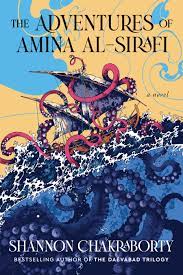
Book Review: The Adventures of Amina al-Sarafi (2023, Kindle Edition)

A creative adventure book with sea creatures, swordfights and a bright psychedelic treasure island. Yes, please!

This was a fun, imaginative read with a unique premise. How often do you read about what happens after a character completes their hero’s journey and retires? Not to mention, the location of the story is also truly special. How refreshing to read a book that takes place in the Islamic East, instead of the average Western locations! And, while the book starts a bit slow, the ending is, truly, an adventure!

The other settings in the book were also amazing, and probably my favorite part of the book. Chakraborty pulled out the big guns with the wonderful treasure island of Socotra, an island in the Republic of Yemen really rumored to have flying snakes (you can read more about the real place HERE. It is a World Heritage Site now!). Other settings included exciting battles on the Marawati against a giant sea monster and a magical psychedelic island with humanoid birds.

I loved the main character, Amina. She had a daring personality with clear motives and flaws that both carried her through the plot, while also leading her into lots of trouble. Amina’s flaws are what make her such a compelling character; she’s not perfect and she knows it! At the same time, her morals guide her through difficult situations. There has been some critique from other reviewers that Amina was too ‘soft’ to be a pirate, but I felt her ideas made sense. She was willing to do what it takes to achieve her goals and stand up for what she believes in. She didn’t flinch to kill someone when she felt it was necessary or deserved. While she wasn’t cruel and her behavior wasn’t outright criminal most of the time, Amina was selfish and morally grey enough to fit her character goal to me.

The book was wonderfully humorous. There were some real laugh-out-loud bits, especially involving Payasam, the Marawati’s live-in cat. I enjoyed the light-hearted style of the writing. It made the book feel like the sort of fun adventure one might dream up as a child—perfect for this type of story.

Chakraborty managed to tackle some heavy topics while she was at it too…the author has a natural way of evoking empathy towards characters that are wronged throughout the book. Truly, she nearly made me cry over the poor tortured sea monster—can you believe that!

Some cons:

I wasn’t crazy about the ‘interview’ style of the story. While it was a nice surprise to find out who Jamal was, I’d have preferred to hear the story directly from Amina. The story would have been told just as well, without the fourth-wall disruptions that didn’t add much to the plot.

The way Raksh’s character was approached was confusing to me: everyone was so afraid of him at the start of the book, avoiding the mention of his name, but when he arrived in the story, he became the ‘comic-relief’ character. In general, everyone was mostly annoyed with him, but nobody was actually scared of him.

The book is also known to have too much ‘soapboxing’, causing it to deviate from ideas normal to 12th century society. And, while I do see why this is said, this is currently a trend in most media and besides, Amina and her crew were outcasts…who’s to say their ideas might not be a bit more progressive than your average 12th century person? But if this sort of thing annoys you as a reader, then this isn’t the book for you.

5 stars from me. This is the kind of book you can read without needing to take it too seriously. I will definitely pick up the next book in the series! If you enjoyed this book, you can also pick up Chakraborty’s other series, The Daevabad Trilogy

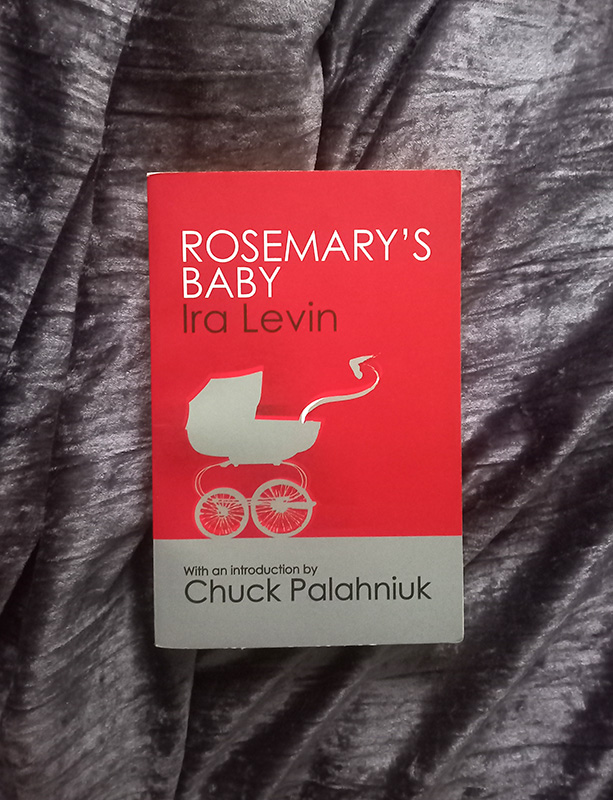
Book Review: Rosemary’s Baby by Ira Levin (2011 Paperback Edition)

Disclaimer: This book has some ideas and words that are considered offensive, especially pertaining to race and gender. It is therefore necessary to consider the time in which the book was written (originally published in 1967). Should you be sensitive to these topics, it might be best to skip this one.

The story was entertaining, the prose flowed elegantly, and the story was well-paced. I raced through this book, barely able to put it down! The clues were well planted, weaving a wonderful web for the reader to untangle. While not being terrifying in the guts-and-gore horror film sense, this book leaves behind a feeling of discomfort that is hard to shake, and suspicion of the potentially harmful people living around us. It shows the horrors people are willing to inflict unto others to meet their own needs. Rosemary’s dream on ‘baby night’ left me feeling a little nauseous and angry on Rosemary’s behalf! The writing was truly powerful.

The main characters were well fleshed out—especially Rosemary. Her intentions are clear and her flaws feed well into the plot to tell a believable story. It draws empathy from the reader as she goes through her ordeal. Levin effectively wrote her naivety and gentle nature to be her downfall. It shows the reader that the same could easily happen to anyone if they place too much trust in the people they consider to be their protectors.  

Guy was a truly dislikable character (intentionally so). His narcissism drove a big part of the plot. He was always around to put Rosemary down, or to tell her she’s being paranoid. Well done to Levin for creating a character almost as dislikable as Jeoffrey Baratheon!

Some negative points on the book: the plot was a little predictable—the book cover gave away the big twist at the end (so that wasn’t great). The ending also fell a little short. While it shows the unconditional love that mothers have for their children, the shift was a bit sudden. There might have been ways to resolve the story more smoothly.

Overall, this book was great and I would recommend it to anyone who enjoys ‘old-school’ horrors. I give it 3.5 stars. It didn’t make a 4-star for me mainly because of the ending. If you enjoy this sort of book, you can also check out Haunting of Hill House by Shirley Jackson—a book I loved and found to be informative for those who want to write their own thrillers and horrors. I’ve recommended it before, and I probably will again!

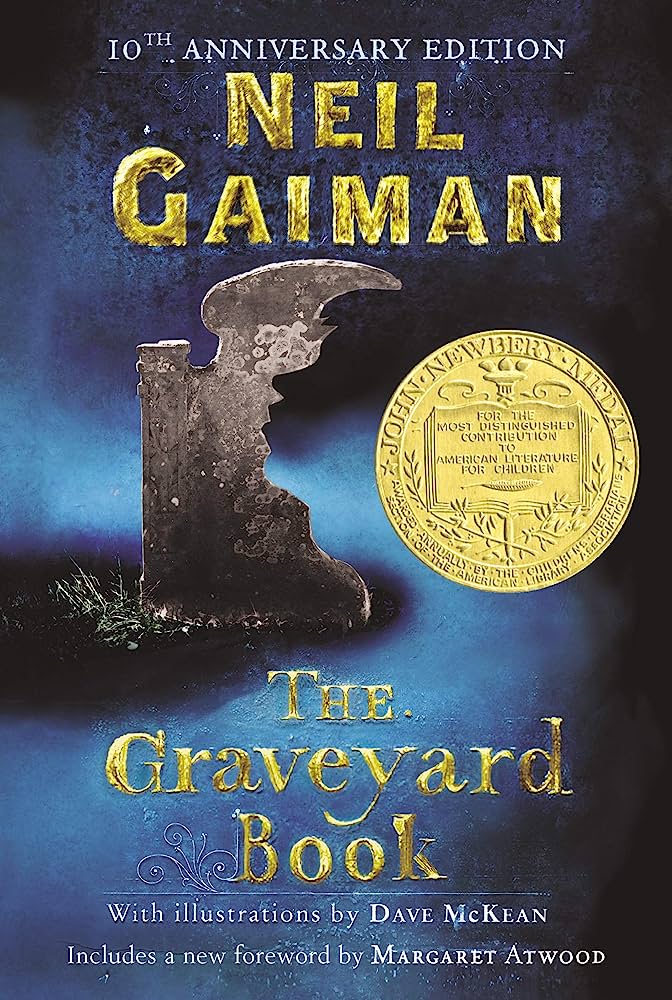
Book Review: The Graveyard Book by Neil Gaiman (2008, Kindle Edition)


The Graveyard Book is a story about a living boy named Bod, who, as a result of a terrible murder, is raised in a graveyard. His new ghostly and otherworldly guardians teach him useful tricks, such as Fading (to hide himself from foes) and history (from those who were there to witness it firsthand!). But soon enough new challenges arise, and Bod faces good and evil from both the lands of the dead…and the living.

I enjoyed this sweet little book very much. It was a short and fun read, and I believe that despite it being targeted at children, this book will be enjoyed by adults too. It had some moments of laugh-out-loud humour, as well wisdom. “A graveyard is not normally a democracy, and yet death is the great democracy, and each of the dead had a voice…” (Page 29).

The characters were all great. Nobody (Bod) Owens was a strong protagonist, who had a great sense of curiosity that kept the story going. Like a typical young boy, if Bod was told not to do it, he was doing it. It was fun growing up with Bod, from the age of a baby to a teenager, and learning about the world as he grew wiser and braver.

My favourite character was Silas, Bod’s self-appointed guardian. Silas is a dark character who found himself in a nurturing role, and the whole thing ends up being hilarious but also endearing. He formed an important role in Bod’s teachings and his journey as the hero!

Miss Lupescu also gets an honourable mention, because she was great. The way Gaiman wrote her stood out above the other characters and made her so memorable. I won’t say too much about her, because I’d probably end up spoiling something important (because everything about this character is mysterious).

The story and the prose was also thrilling. While the plot was relatively simple, it was still filled with fun moments that really had me wishing I could step into the book and experience it with the characters. The ending of the story had me crying—in a good way! I wanted to give both Bod and Liza a hug. The writing of the book was atmospheric and beautiful, and I loved that Gaiman didn’t ‘dumb down’ the text simply because it’s a children’s book. I know for sure I’d have LOVED this book if I read it as a kid.

This was a 4-star read for me—totally worth it if you enjoy a dark chocolate story (sweet but a little grim). You can also check out Neil Gaiman’s other books that can be enjoyed by adults and children, such as Stardust (1999) and Coraline (2002) (Coraline is still my all-time favourite Neil Gaiman book). An adult book with a similar vibe that I also loved was Gaiman’s Neverwhere (1996), featuring dark tunnels and an appearance of the infamous Rat King.

Book Review: The Shining by Stephen King (1977, Kindle Edition)

The Shining is one of those books you simply have to read if you enjoy classic horrors. I really wish I’d read the book before I watched the movie, because it was hard to separate myself from it. Some of the most iconic scenes from The Shining do, after all, not even appear in the book. And Wendy…wow. Totally different person in the King version compared to the Kubrick version.

The book follows the Torrance family—Jack, Wendy and Danny—as they spend the winter taking care of the notorious Overlook Hotel. The catch is that when the blizzards bring the heavy snow, the hotel is cut off from the world, only reachable via radio and snowmobile. Danny, Jack and Wendy’s young son, has an ability to ‘shine’: a psychic skill that shows Danny visions of the future. The longer the family stay in the hotel, the clearer it becomes that the hotel has a life of its own and Danny’s visions become more and more disturbing.

Here are my thoughts:

The Shining was a great book. While it certainly wasn’t the gore and in your face horror we are exposed to today, there were parts of the book—the human horrors—that forced me to have to take a break from reading every other page because I was genuinely disturbed. King wanted to scare me, and he did a great job of it.

This is especially prominent during scenes from Jack’s point of view. His constant battle against himself—the alcoholism, his temper and conflicting feelings towards Wendy and Danny. He has such wonderful inner conflict, constantly telling himself that he has it all under control when we as the reader can clearly tell that’s not the case (pretty much from page 1!).

King is the master of great characters. Each voice felt distinct, with each character having their own well developed inner world. I especially liked Wendy. She was very endearing and sweet, and it was easy to empathise with her struggle. She seemed to really want the best for her family and, while clearly having some negative feelings towards the family’s stay at the Overlook, she tried her best to make the most of it.

The story settings were great too. I loved the descriptions of the hotel, especially in the first few chapters on the hotel’s closing day. The vibe was grandiose and bustling, full of life and colour.

And when it comes to settings, beware the hedge animal scenes. Those were really creepy…not the animals themselves, but that slow, stalking feeling that King creates through pace and description. Just amazing! Never thought a haunted plant could creep me out, but here we are…

The plot was also enjoyable. It kept me on my toes even though we are told from the beginning how we can expect the book to end. I would have preferred a little less foreshadowing—it’s not great to literally be told how the book is going to end, regardless of whether this helps to build tension.

Overall, a 4-star read for me. If you enjoyed this book, also check out The Haunting of Hill House by Shirley Jackson—yes, there’s a book! King pulled a lot of inspiration from Jackson’s creepy tale, which really is the OG haunted house story.

Book Review – Mythago Wood by Robert Holdstock (1984, Kindle Edition)

This book was recommended on Bookstagram and I was immediately intrigued by the concept of the mysterious dark forest and mythical creatures. This book is a fantasy classic and had a big influence on the fantasy genre; it even won the World Fantasy Award! It sounded right up my alley, but sadly did not live up to my expectations.

Mythago Wood follows the story of Steven Huxley, who returns to Oak Lodge, his family home, after being injured in the war in 1945. Steven’s brother, Christian, now lives at the lodge after their father, George Huxley, died. George had spent most of his life obsessively studying Ryhope Wood, a ‘wildwood’ or ‘primary oak wood’ situated on the outskirts of the lodge in Herefordshire. Steven makes it clear from the beginning of the story that he believes his father’s obsession with the wood tore apart the family and drove his father mad. Soon after returning to the lodge, Christian disappears into the wood, prompting Steven to start reading his father’s work in order to discover what may have happened to his brother. He comes to know about Guiwenneth, the girl who becomes to love interest of the story, and also learns about the ‘mythagos’, mythical creatures generated from the minds of those living close to the wood. “The Mythagos grow from the power of hate, and fear, and form in the natural woodlands from which they can either emerge…or remain in the natural landscape.” (Page 52)

The story started off interesting. I liked the strange atmosphere of the woods and the specific descriptions of local plants that showed Holdstock did his research. The structure of the book was straightforward and clear, the various settings were vivid and the detailed worldbuilding had a lot of potential. Despite this, there were several pitfalls throughout the book.

The most disturbing of these was the representation of the woman characters. The two most prominent women in the book were Guiwenneth, the Celtic warrior princess, and Kushar, the life-speaker of the Shamiga woodland tribe. Both were poorly depicted and, while early fantasy is infamous for its lack of strong female depiction, this book took the cake by far and here’s why:

Guiwenneth is described as being sixteen or seventeen, with many childlike characteristics: always giggling, innocent and small of stature. This didn’t sit well, as the male protagonist was many years her senior and continually described her sexuality and her ‘sexy’ animal-like aroma (Page 97). He quickly fell in love (or lust?) with her, and his entire attraction to her was based on her childlike nature. The other two Huxley men were also attracted to her, despite all of them being much older than her. Many other reviewers described Guiwenneth as being a typical ‘manic pixie dream girl’ (coined by Nathan Rabin): a quirky, ‘free’ female character with a troubled past, present mainly to guide the male protagonist and remind him of the values of life. Furthermore, even though Guiwenneth was introduced as being powerful, being a warrior princess, Steven had to come to her aid on several occasions—it’s the premise for his whole venture into the woods! Kushar, the second female character, was also 11 or 12, and appeared fully naked in the book, the author even describing various aspects of her nude body. This felt unnecessary and was very disturbing.

Another aspect of the story I struggled with was the many complicated and constantly changing names in the book. While I don’t usually mind fantasy names at all, in this case, some names would be mentioned with many page gaps in between, and I’d have to page back to check who the person in question was. Sometimes the character would be called by a whole different name than the one I’d come to know, and I’d have to guess who this name was implying.

Lastly, while the world and myths were very interesting, the way these elements were presented could have been done better. I was often confused, sometimes being fed too much ‘mythological’ exposition that hadn’t been explained yet (through George’s diary entries), or that could have been explained more effectively through showing instead of telling.

While I believe this book had its place and time, and I’m sure there are others who would enjoy it more than I did, I would rather recommend a book like the Dark, Dark Woods on Wattpad for those who want a fantastic dark woods fantasy. You can read it at this link: https://www.wattpad.com/story/269950595-the-dark-dark-woods.

I’d have given Mythago Wood 3.5 stars, but the problematic female representation made me bump it down to 2 stars.

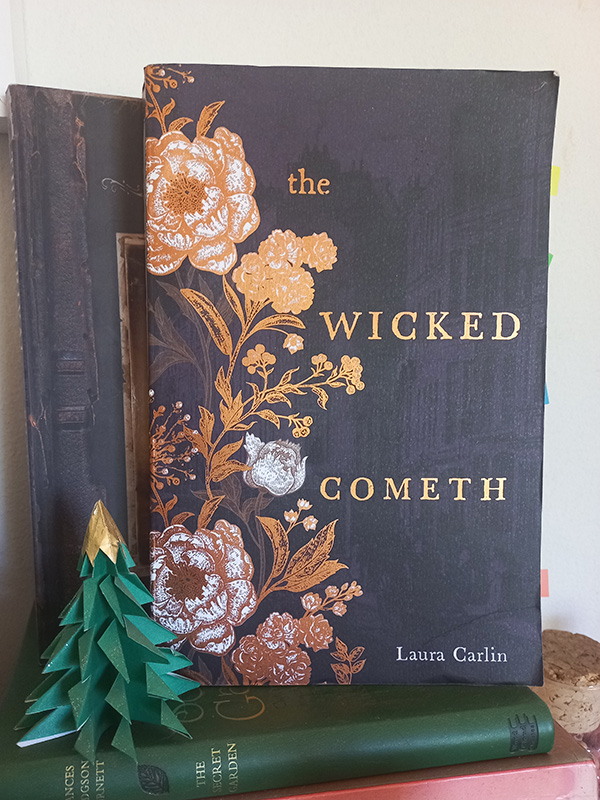
Book Review – The Wicked Cometh by Laura Carlin (2018 paperback version)

‘We have no need to protect ourselves from the bad sort because WE are the bad sort . . .’

The Wicked Cometh is a gothic historical mystery novel based in the 1830’s, London, during the end of the Romantic Period and beginning of the Victorian Era. It follows the story of Hester White, who, due to the death of her parents and thereafter poor decisions taken by her foster parents, begins the story living in the slums of London. Her main wish is to escape the squalor of Virginia Row and Austin Street and make a better life for herself. She soon comes in contact with the aristocratic Brock family, who takes her in to test whether she can be educated and become a ‘worthy’ member of society, Pygmalion-style. Alongside this, there is also a mystery aspect to the story: people from the slums—those considered unimportant—are going missing. The police however, seem to be doing nothing to find the missing persons. When Hester encounters Rebekah Brock, a woman cursed with too much ‘manly’ intelligence for her uncle and brother to bear, the two begin to investigate these disappearances and a dark London underworld is revealed.

The Wicked Cometh is a highly entertaining, fast-paced book filled with history. I read it in a week—which for me, only having about an hour’s time to read before bed, is quick.

I really enjoyed the various settings of the story, from the grim streets of London to the grandeur of the Brock household. Carlin has a knack for description—I was enchanted by the sights of beauty she conjured and felt thoroughly disgusted by the scenes of horror found at the School of Morbid Anatomy and Physiology. There was a scene in which one of the experiments of the doctor is described that was more horrifying even than some of the scenes described by Stephen King. I mean, how vivid is this image?

“A sickly, rotten stench rises from the streets and the rain-bloated gutters. Some thoroughfares bulge with black mud where pools of fetid water have collected, while others are meandering.” (page 5).

Can Carlin please write a horror? I feel like I need a Carlin horror in my life.  

The main characters, Hester and Rebekah, were very interesting, although they sometimes read a bit like the same person. Hester’s character stood out to me in moments where she took charge—playing the part of Annie Allsop with her London vowels. These moments really made her shine. Both Rebekah and Hester tended to be melodramatic. Hester’s actions were even creepy sometimes, overstepping privacy boundaries in order to attain information essential to the plot. These moments, including chance encounters and serendipitous eavesdropping, made the storyline feel a bit ‘convenient’ at times. The characters would risk their safety and sanity to seek out bits of information that I simply couldn’t imagine a real person doing (but at the end of the day, this is fiction).

The relationship between Hester and Rebekah was intriguing and is truly unique in this Victorian era setting. The pacing of the romance was unfortunately not perfect; it was too much too soon, and then not quite enough in the second half of the book. Despite this, it was still insightful and entertaining to read.

The plot was very exciting—I was kept on my toes until the very end. Carlin planted excellent red herrings. The subject matter—grave snatching and reanimation, along with exploitation of the poor—made for an interesting retelling of a very real and gruesome history. Let’s be honest, even the incredible Mary Shelly could not resist conjuring Frankenstein from these historical events.

The prose, while needing some tightening here and there, was smooth to read and had some beautiful paragraphs of poetic writing.

“Whether it is the style of heel the cobbler has nailed to Blister’s footwear, or my feelings towards the man, but to me his tracks are cloven hoofs and a forked tail, and I wonder if we are following the devil himself.” (Page 217).

Overall, a 4-star read for me (Amazon rating 3.8 and Goodreads rating 3.4). The book was thoroughly enjoyable and an admirable first novel for Carlin. I would certainly recommend it as a light read if you enjoy a bit of gore.

Book Review: Demon Copperhead by Barbara Kingsolver (Kindle Edition)

Since Demon Copperhead is such a hype book (queue Oprah), I was sceptical to jump on the bandwagon for the fear of being disappointed. I can however tell you, that this book was worth every penny. Please, do yourself a favour and pick this one up. Thank you.

Demon Copperhead is a Bildungsroman, or a coming-of-age story inspired by Charles Dickens’ David Copperfield. Demon Copperhead is set in Southern Appalachia, Lee County, and is about a boy born to an addict teenage mother in a trailer. His life becomes a battle with abandonment, death, addiction, foster care and love – the good and the bad sort.

The first thing that caught my attention was the unique writing style, the voice of the protagonist Demon, real name Damon Fields. Every other page, I found myself highlighting a quote, laughing out loud or smiling. Try this one on and see for yourself: “It was hot as hell in there, and crowded with knickknacks and whatnots all over the place. Big old clocks on the mantel, and I’m saying more than one. If you wasted this lady’s time, she was going to know it.” (Page 288) and “She asked more questions, such as why Mom took up with such a bad apple after my father died. I could think of a few answers, starting with Mom having shit for brains, but due to politeness I just said lonesome I guess.” (Page 237). There is humour in each sentence, balanced well with bits that make you think wow, that’s actually really sad. Demon’s character is formed from the first sentence by this narrator’s voice; I instantly loved him and wanted to know his story.

This voice that Kingsolver used to tell Demon’s story stays uniform throughout the book. The story takes place over a long period of time, where Demon develops from a boy to a young man. She adjusts the voice subtly to become darker and more adult towards the end of the story, while at the same time keeping the unique language of Demon intact.

Demon’s heritage plays an important part of his voice and story, being ‘Melungeon’ and a ‘redneck’. He describes Melungeon to be a derogatory word given to a group of people from the Appalachian mountains, of mixed origin (origin including Portuguese and Cherokee). This group eventually turned the negative connotations of the term around and started using it as a term of pride (Page 313). He describes rednecks as “Twenty thousand guys from all over these mountains, fighting in regiments. They wore red bandannas on their necks to show they were all on the same side, working men…people calling us rednecks, that goes back to the red bandannas. Redneck is badass.” (Page 325). These cultures are very foreign to me, having grown up in Namibia, Africa. It was insightful and truly refreshing to read a story from the perspective of a protagonist from this area, thrown into the school setting from the late 80s and early 90s timeframe.

There were a lot of characters in the book, but the ones that really drew me in were Angus and Maggot. They were both such wonderful compliments to Demon’s life – one for stability and one to show him a mirror of his own mistakes. They truly stood out, both having such eccentric personalities. Demon’s character was also well developed and, even though at times I wanted to shake him for his stupid choices, I could understand why he made those choices.

The story itself was at times hard to take in, purely because it was painful to read what Demon was going through. He spent his entire childhood dealing with abandonment, from the moment he was born. But his character is built on resilience, choosing to laugh at the pain and make something positive out of anything. This makes the parts where Demon does break down so much harder, because you truly understand that this is a moment in the book that hit him hard. My favourite part of the book was where Demon moves out of Dori’s home and the chapter ends with him dealing with dear old forgotten Jip. This part tells so much to me about who Demon is, and how he still cares for those who have wronged him. Sorry, you’ll have to read it to understand what I’m on about.

Once we reach the halfway mark of the book, the story slows down. This was due to the story actually going well for Demon for a little while; he’d become a rising football star and had a taste of being the ‘popular kid’. At last, some stability…but of course, like a roller-coaster, we know that when things go up, they’re probably going to come back down and probably at ten times the speed.

Reading the second half of Demon’s story really did bring everything full circle for me, all the way to Devil’s Bathtub, the place his father was known to have died.

By the end of the story, all the necessary loose ends had also been tied up with a positive new adventure on the horizon.

I give this story five stars. It was an amazing read and I recommend it to anyone who enjoys stories of characters overcoming immense difficulties. If you don’t enjoy strong language or discussions about addiction, then this one is not for you. It can be considered triggering to those dealing with similar issues.

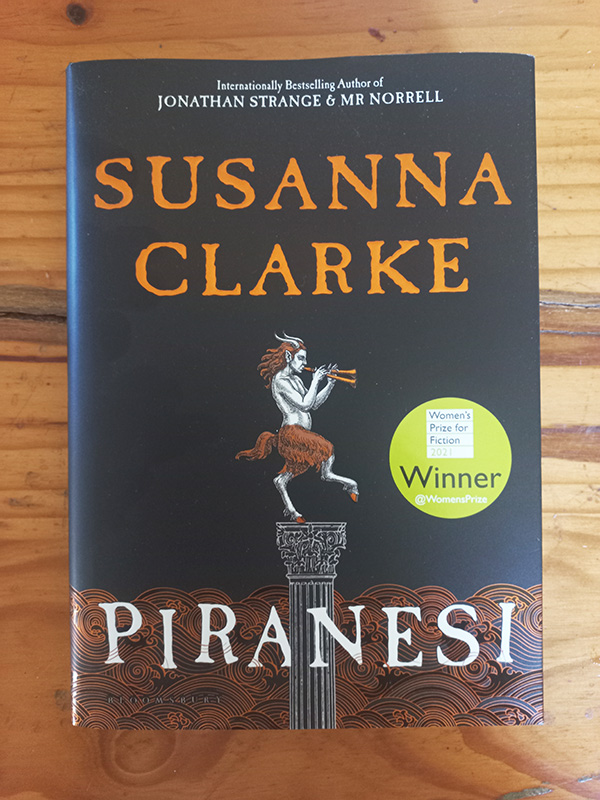
Book Review: Piranesi by Susanna Clarke

This strange yet wonderful novel is a philosophical fantasy story about a man called Piranesi, who lives in the House, a maze of hallways that are equally intriguing as Piranesi himself. Piranesi is a scholarly character who studies the House, keeping careful records of his daily observations, drawing maps of the halls, the stars and the statues. The only other living human in the House is the Other, a man with whom Piranesi shares his research. One day, however, their peaceful existence is threatened by someone new, someone who should not be in the House.

This book really kept me thinking after I read it. While the book does have a strong sense of mystery about it—you’re constantly trying to figure out who, what and why—I found that the real hook of the story is in learning about Piranesi. Piranesi’s character is wonderful; we can all learn a thing or two from him. He is patient, kind and very empathic. Once the mystery becomes unravelled, this part of his character becomes even more admirable. Piranesi is well-developed and I really enjoyed viewing the world through his eyes.

I’ve heard some reviewers say that this book falls prey to the ‘Paradox of Mystery’ (See Shaelin Bishop’s video on this topic at https://www.youtube.com/watch?v=okOh3k1gxZE). This occurs when the mystery is more interesting than the answer to that mystery. In this case, the mystery of how Piranesi came to be in the House, as well as the mysterious events threatening his existence, would be considered more interesting than the answer to those questions. I find that I can neither agree nor disagree; this is one of those stories where I believe it’s important to focus on the journey, rather than the destination. The answer to the mystery is revealed slowly but surely, and I feel it suits the voice of the story.

I found the worldbuilding in this story to be very interesting, although I’d have almost liked the book to be just a little longer to accommodate more descriptions of the interesting scenery offered up by the House. What does it feel like being surrounded by all those empty rooms, all those litres of rushing and thundering water? What does it taste like to stand within a cloud? Clarke does use beautiful descriptive prose, “This tide(‘s) foam was the white of old fishbones, and its churning depths were pewter” (Page 4), but Piranesi would have flourished with just a little more atmosphere. This book would have been the perfect candidate for adding drawings and little maps in-between, as if they were drawn by Piranesi in his research.

The academic structure of the story is also compelling. This a strong feature of Clarke’s writing style, as seen before in Johnathan Strange and Mr Norrel (which I absolutely adored). While some parts of the book were perhaps a little slow because of this, I feel like this was an important element of the story and it would not have had the same impact without this.

The beauty of the world through Piranesi’s eyes is what really stuck to me. Whether you wish to read into the symbolism of each statue of the House (and there certainly are readers who have spent hours on this) or whether you go into it blindly like I did, I think the book has something wonderful to say: no matter your circumstances, the world will offer you beauty and kindness as long as you treat it with respect.

I give this book 4.5 stars, overall fantastic. If you enjoy fantasy with a touch of academia, I definitely recommend this book. If you wish to start reading Clarke’s work, I would recommend starting with Piranesi before moving on to a heavier novel like Johnathan Strange and Mr Norrel; it contains a lot of footnotes that can throw a reader new to this sort of writing off. Readers who enjoy this book may also enjoy Tomorrow by Damien Dibben.

The King Of The Wild

A poem by Katherine Hunter

The invisible people wander around
through tales of birds and hollows unfound
They serve copper dishes and twitter to ghosts
they scamper on roofs built by their hosts
The boy sits upon his throne
where the wind swirls and howls,
and cuts through bone
As the mighty thorned giant stares ahead
its gaze follows the striped King who walks on
with eyes white and dead.
He disappears into the scent of frosted flowers
fading into falling blue and golden showers.
But still, nobody listens and nobody knows
about the tales written by the girl
in orange-blossom clothes.

Lost

A poem by Katherine Hunter

I cup a feather in my hands
A tiny pool of speckled grey
It turns into a little bird
And flies to somewhere far away

Summer warms up the winter sky
and blows a breeze through sun-kissed hair
It floats along an ocean wave
And meets you in the air

A pitter-patter of raindrops scatter
On to the roof above your head
A little bird makes a nest in a tree
As you drift gently to sleep in bed

Snowflakes fall and I wish you well
I have left my heart with you
While the seasons change and the days don’t come back

I’ll wait until you do.