
Review originally published on Reedsy Discovery. View it HERE.
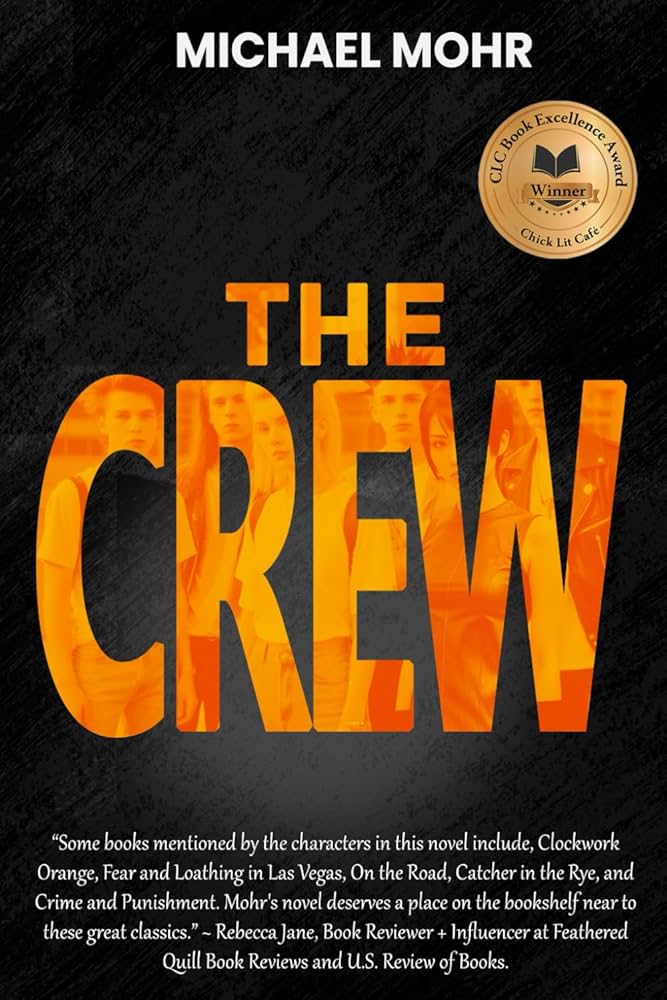
All sixteen-year-old Jack Donnigan wants is to rebel against the systems that control him—his protective mother, his ‘dictatorlike’ school principal and limiting societal norms. He decides to set change into motion by approaching a member of The Crew, an infamous group of punk kids from Jack’s school. This group is ruled by Cannonball, who eagerly accepts Jack into The Crew, christens Jack with the new name ‘Dog’, and introduces him to punk culture icons such as Johnny Rotten from the Sex Pistols and The Ramones, and books like Crime and Punishment (Dostoevsky) and 1984 (George Orwell). As Jack begins to carve his way into his rebel lifestyle, he finds new challenges awaiting him—some of which may lead him to the most difficult choices he’s ever had to make.
This story is incredibly well-written, the prose including strong metaphorical language and the story’s voice shining with personality:
“The faces of the nerds I’d spent time with freshman year buzzed across my mental landscape. I wanted to hurl my fist into one of their faces. But they’d been so unbelievably kind. Compassionate my mother would probably say. Whatever. I wanted to smash their compassion.” (Page 18).
I absolutely devoured The Crew. I loved that the book included punk references—they really added to the story. Lines such as “Life replaced theory” from Crime and Punishment (Dostoevsky) gave Jack guidelines to follow in his search for emancipation from the system. Jack’s reaction to hearing these quotes, however, also shows the reader how naive Jack can be—often misunderstanding or reinterpreting these guidelines to suit his selfish needs. It made for great juxtaposition, creating the perfect flawed character.
Jack is a wonderfully complex character, who despite his mistakes, is easy to empathize with. Anyone who has gone through even a small rebellion in their life can put themselves in Jack’s proverbial Chuck Taylors. From the moment Jack—now Dog—joins The Crew, he orchestrates his transformation, carefully assessing each leg of the journey as it comes. He looks at the systems he wants to break down, then analyses the systems within The Crew to build his way up within the hierarchy.
“For me individuality was key… (to base decisions) on my own understanding, my own experience, my own examination of life, my own existential beliefs. That had…dictated everything about me as far back as I could remember.” (Page 191).
Despite his careful thinking, Jack’s naivety and lack of experience cause him to misstep; he often mistakes arrogance for power or lust for love.
“I’d metamorphosed, like I’d wanted to, only I’d become…something foreign and ugly.” (Page 162).
He is, in essence, still only a sixteen-year-old boy transitioning into the complex world of manhood.
A critique that I have toward Jack’s character is that I wish Jack’s backstory had been told in a little more detail. His need for rebellion stems from childhood issues which are only touched on briefly. Perhaps a more detailed flashback-style chapter would have brought these issues to life, helping us understand Jack even better.
The other characters in the story were vivid and added great flavor and tension to The Crew:
Cannonball appears to be a powerful new friend to Jack, yet the reader senses straightaway that their meeting has set into motion events that will not be easy to witness. Cannonball is the leader of The Crew and he’d like to keep it that way regardless of who may be hurt in the process.
Bear, who joined The Crew after Jack, serves as a mirror for Jack to assess how he himself places within The Crew’s hierarchy. When Cannonball treats Bear like a slave, Jack can see that Cannonball’s leadership stands against everything The Crew rejects; if Bear can be ordered around by Cannonball and ruled by the fear of punishment, isn’t Cannonball just another ‘fascist dictator’?
“In short, Cannon had become…the prodigal son of the system.” (Page 191).
Sarah, Jack’s love interest, was a difficult character for me to place. Her and Jack’s relationship goes from zero to a hundred very quickly, yet we know little about her. I wanted to know more. At the same time, Mohr seems to have kept information about Sarah purposefully limited, because Jack himself doesn’t care as deeply for Sarah as he thinks he does. Again, the world of romantic relationships is brand new to Jack. He has no idea what he’s doing! He seems to be in love with the idea of Sarah, not who she really is.
The Crew has a very open-ended ending. One asks: what will happen to Jack now? How will he survive and who will he turn to for help? Despite this open ending, a metamorphosis of character has clearly occurred, and the reader feels satisfied that this chapter of Jack’s story has come to a close. What I do know with certainty is that if Michael Mohr wrote The Crew 2, I would definitely be reading it.
TRIGGER WARNINGS: Drug use, References to abuse, Mild Violence, Political/Religious Views
 Maan Atelier