
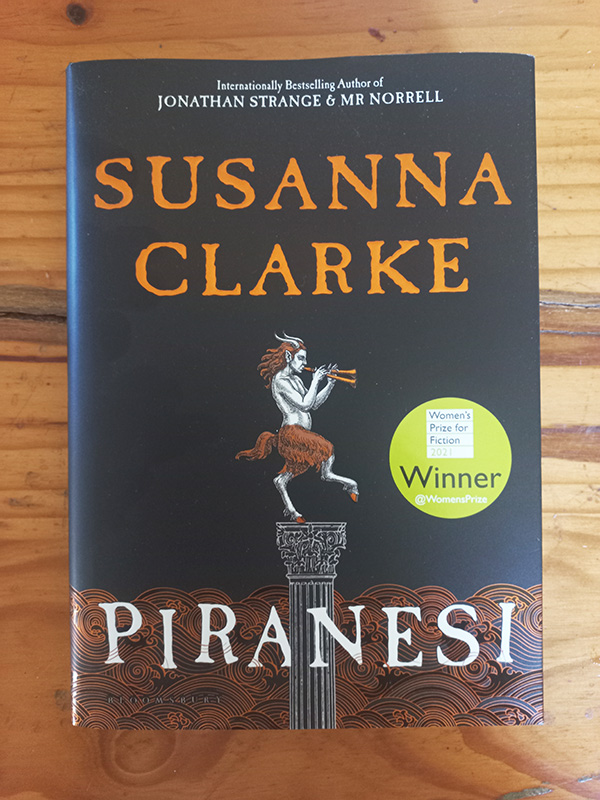
This strange yet wonderful novel is a philosophical fantasy story about a man called Piranesi, who lives in the House, a maze of hallways that are equally intriguing as Piranesi himself. Piranesi is a scholarly character who studies the House, keeping careful records of his daily observations, drawing maps of the halls, the stars and the statues. The only other living human in the House is the Other, a man with whom Piranesi shares his research. One day, however, their peaceful existence is threatened by someone new, someone who should not be in the House.
This book really kept me thinking after I read it. While the book does have a strong sense of mystery about it—you’re constantly trying to figure out who, what and why—I found that the real hook of the story is in learning about Piranesi. Piranesi’s character is wonderful; we can all learn a thing or two from him. He is patient, kind and very empathic. Once the mystery becomes unravelled, this part of his character becomes even more admirable. Piranesi is well-developed and I really enjoyed viewing the world through his eyes.
I’ve heard some reviewers say that this book falls prey to the ‘Paradox of Mystery’ (See Shaelin Bishop’s video on this topic at https://www.youtube.com/watch?v=okOh3k1gxZE). This occurs when the mystery is more interesting than the answer to that mystery. In this case, the mystery of how Piranesi came to be in the House, as well as the mysterious events threatening his existence, would be considered more interesting than the answer to those questions. I find that I can neither agree nor disagree; this is one of those stories where I believe it’s important to focus on the journey, rather than the destination. The answer to the mystery is revealed slowly but surely, and I feel it suits the voice of the story.
I found the worldbuilding in this story to be very interesting, although I’d have almost liked the book to be just a little longer to accommodate more descriptions of the interesting scenery offered up by the House. What does it feel like being surrounded by all those empty rooms, all those litres of rushing and thundering water? What does it taste like to stand within a cloud? Clarke does use beautiful descriptive prose, “This tide(‘s) foam was the white of old fishbones, and its churning depths were pewter” (Page 4), but Piranesi would have flourished with just a little more atmosphere. This book would have been the perfect candidate for adding drawings and little maps in-between, as if they were drawn by Piranesi in his research.
The academic structure of the story is also compelling. This a strong feature of Clarke’s writing style, as seen before in Johnathan Strange and Mr Norrel (which I absolutely adored). While some parts of the book were perhaps a little slow because of this, I feel like this was an important element of the story and it would not have had the same impact without this.
The beauty of the world through Piranesi’s eyes is what really stuck to me. Whether you wish to read into the symbolism of each statue of the House (and there certainly are readers who have spent hours on this) or whether you go into it blindly like I did, I think the book has something wonderful to say: no matter your circumstances, the world will offer you beauty and kindness as long as you treat it with respect.
I give this book 4.5 stars, overall fantastic. If you enjoy fantasy with a touch of academia, I definitely recommend this book. If you wish to start reading Clarke’s work, I would recommend starting with Piranesi before moving on to a heavier novel like Johnathan Strange and Mr Norrel; it contains a lot of footnotes that can throw a reader new to this sort of writing off. Readers who enjoy this book may also enjoy Tomorrow by Damien Dibben.
 Maan Atelier